The $18 Trillion Problem: Why Shoppers Abandon Their Carts
Imagine a customer adding items to their online cart, heading to checkout, and then… disappearing. This isn't some internet myth; it's the frustrating reality of shopping cart abandonment. This common problem impacts businesses worldwide, resulting in a staggering $18 trillion in lost sales every year. So, why are so many shoppers leaving their carts full of carefully chosen items? Understanding this is crucial for unlocking significant revenue potential.
One major culprit is unexpected costs. Think about the last time you were about to buy something online, only to be surprised by hidden fees at checkout. These unexpected shipping costs, taxes, or other extra charges often deter shoppers. Similarly, a complicated checkout process can lead to frustration. Requiring account creation, lengthy forms, or confusing navigation can quickly turn a pleasant shopping experience into a tedious chore.
This isn't an isolated issue. Shopping cart abandonment affects e-commerce businesses globally. The average global abandonment rate sits around 70.19%, according to aggregated data from multiple studies (Baymard Institute). This means nearly seven out of ten potential purchases are never completed. Abandonment rates fluctuate by industry and region, with sectors like home furnishings and jewelry seeing even higher rates—78.65% and 81.68%, respectively. The financial implications are substantial, with billions of dollars lost annually. Understanding these statistics is key for businesses looking to optimize their checkout process, reduce abandonment, and boost conversions.
The Psychology of Abandoned Carts
Beyond the practical aspects of checkout design, there are also psychological factors at play. Sometimes, shoppers abandon their carts simply to compare prices on other websites. This "comparison shopping" is particularly common with more expensive items. Other times, it’s just a change of mind. The shopper might reconsider the purchase or decide to wait for a sale.
Turning Abandoned Carts into Opportunities
While cart abandonment is a challenge, it also represents a huge opportunity. By addressing the root causes—from unexpected costs and complex checkouts to those psychological barriers—businesses can recover lost sales and improve their bottom line. This involves creating a streamlined, transparent, and user-friendly checkout experience that builds trust and encourages completion.
Device Battlegrounds: Why Mobile Shoppers Abandon More Often
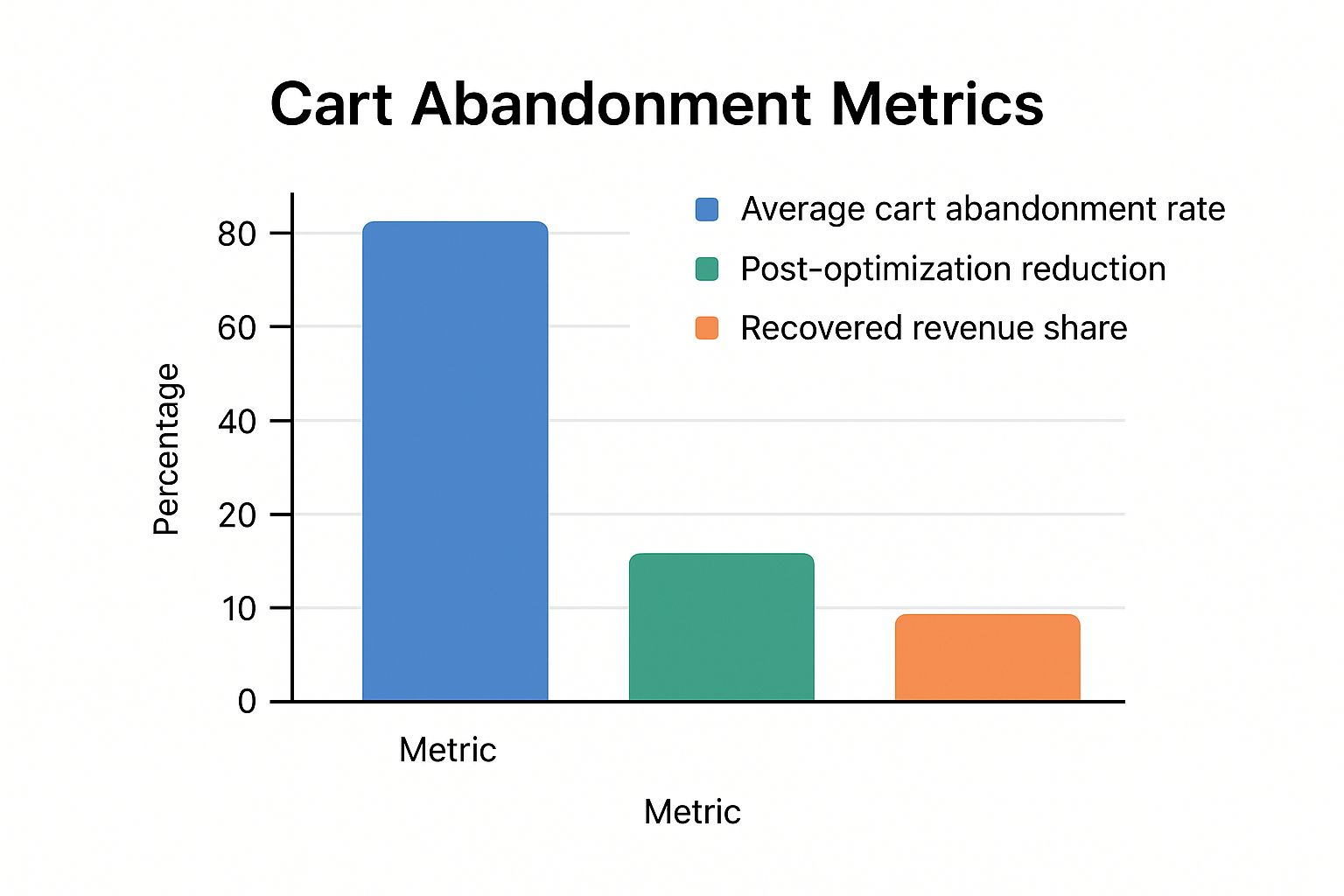
The infographic above illustrates the impact of shopping cart optimization. It shows average cart abandonment rates, the potential for improvement, and the resulting increase in recovered revenue. Even a 20% reduction in abandonments can recoup 10% of lost revenue—a significant boost for any business.
Mobile commerce is booming, with consumers constantly connected. However, this presents unique challenges for online retailers. Mobile cart abandonment rates often exceed those of desktop users, requiring a tailored approach to optimization.
The Mobile Challenge: Thumbs, Screens, and Patience
One key reason for higher mobile abandonment rates is the inherent limitations of the devices. Smaller screens, awkward "thumb zones", and slower loading speeds create friction in the checkout process. Imagine trying to complete a complex form one-handed on a crowded train. Frustrating, right? This experience often leads shoppers to abandon their carts.
Mobile users are also more prone to distractions. A notification, a phone call, or a change in their surroundings can disrupt the checkout flow. This highlights the need for a quick, seamless, and distraction-free mobile checkout experience.
Cart abandonment rates vary considerably by device and region. Mobile phones see rates between 75.5% and 85.65%, compared to 70% to 73.07% for desktops. This underscores the need for improved mobile checkout experiences.
Regionally, the Middle East and Africa have the highest rate at 93%. The Nordics and North America experience rates of 80% and 76%, respectively. These variations necessitate optimization strategies tailored to specific markets and devices. More detailed statistics can be found here.
The following table further illustrates these differences and highlights key areas for improvement:
Cart Abandonment Rates by Device and Region
This table compares cart abandonment rates across different devices and geographical regions to highlight where optimization efforts should be focused.
| Category | Abandonment Rate (%) | Key Optimization Focus |
|---|---|---|
| Mobile (Global) | 75.5 – 85.65 | Streamlined checkout, thumb-friendly design, faster loading |
| Desktop (Global) | 70 – 73.07 | Simplify forms, clear calls to action |
| Middle East & Africa | 93 | Localized payment options, address auto-completion |
| Nordics | 80 | Mobile-first design, personalized recommendations |
| North America | 76 | Guest checkout, secure payment gateways |
As the table shows, focusing optimization efforts on mobile users, particularly in regions like the Middle East & Africa, can yield significant improvements. Prioritizing streamlined checkouts and mobile-friendly design can significantly reduce abandonment rates and increase conversions.
Winning the Mobile Battle: Responsive Design and UX
Combating mobile cart abandonment requires prioritizing responsive design. This means building a website that adapts seamlessly to different screen sizes and orientations. It’s about creating a consistent and user-friendly experience on any device.
Optimizing for Touch: Form Fields and Button Sizes
Responsive design goes beyond just resizing images. It involves rethinking the entire checkout flow. Simplify form fields, enlarge button sizes for easier tapping, and minimize the steps to complete a purchase.
Offering guest checkout eliminates the need for account creation, a common friction point. These seemingly small changes drastically improve the mobile user experience and encourage conversions. By prioritizing a smooth and intuitive mobile checkout, retailers can capitalize on the enormous potential of the mobile market.
Email Recovery Magic: Turning Abandoned Carts Into Revenue

We've explored why shoppers abandon their carts. Now, let's discuss winning them back. Abandoned carts don't have to mean lost sales. They're an opportunity to re-engage customers and recover revenue. One of the most effective methods? Targeted email campaigns.
The Power of the Abandoned Cart Email
Email is a direct line to your potential customer. It reminds them about the items they left behind, addresses any concerns, and persuades them to complete the purchase. But not all abandoned cart emails are created equal.
Email campaigns are vital for abandoned cart recovery. Dedicated cart recovery emails boast a 39.07% open rate and a 23.33% click-through rate. Even more impressive is the multi-email approach. Three strategically timed emails can generate $24.9 million compared to $3.8 million from a single email. These figures highlight the revenue potential of a well-crafted email strategy. Learn more about effective cart recovery emails here. A comprehensive email sequence can dramatically increase your recovered sales. You might also be interested in: How to master revenue optimization.
Timing is Everything: The Optimal Email Sequence
A single abandoned cart email is good, but a series is better. A well-timed, three-email sequence is the gold standard for cart recovery.
-
Email 1: The Gentle Reminder. Send this within one hour of abandonment. Remind the shopper about their cart items and provide a direct checkout link.
-
Email 2: Adding Value. Send this 24 hours later. Offer free shipping, a small discount, or highlight product benefits.
-
Email 3: The Last Chance. This email, sent 72 hours after abandonment, creates urgency. Offer a final discount or remind them that items might sell out.
Crafting Compelling Content: More Than Just a Reminder
Your email content is as important as the timing. Use clear, concise language, highlight key product benefits, and personalize the message. Including customer reviews or testimonials builds trust and encourages conversions.
Segmentation for Success: Tailoring the Message
Segmenting your emails allows for further personalization and targets specific customer groups. You might offer a different incentive to a first-time buyer versus a repeat customer. This targeted approach makes your emails more relevant and improves their effectiveness. By implementing these strategies, you can transform abandoned carts into valuable revenue streams.
Frictionless Checkout: Why Every Extra Step Costs You Money
The checkout process is the final step in a customer's journey. It's the point where they transform from a browser into a buyer. But all too often, it's also the point where potential sales fall apart. Every unnecessary hurdle, every extra field, and every added second can lead to lost revenue. Let's explore why a simplified checkout is crucial for your bottom line.
The Impact of Simplicity
Imagine trying to navigate a complicated maze just to buy a single item. This frustrating experience is often what online checkouts feel like for customers. Studies consistently show that streamlining the checkout process has a major impact on conversion rates. By reducing the number of form fields, offering a guest checkout option, and providing clear progress indicators, you create a smoother, more enjoyable experience. This translates directly into more completed purchases and higher profits.
Form Design: Less Is More
Form design plays a vital role in shopping cart optimization. Long, complicated forms with numerous required fields can quickly overwhelm customers. Asking for non-essential information, like a customer's birthday or how they found your store, adds friction at a critical moment. Focus on requesting only the essential information: name, shipping address, email, and payment details.
To optimize your forms, follow these best practices:
- Minimize required fields: Only ask for information absolutely necessary for order fulfillment.
- Use clear labels: Make sure field labels are short, sweet, and easy to understand.
- Implement auto-fill: Take advantage of browser auto-fill to speed up the process.
These seemingly small changes can make a big difference in form completion times and improve the user experience.
Let's take a look at how various checkout elements can impact your conversion rate:
To help illustrate these points, let's examine the following comparison table:
Checkout Optimization Elements and Their Impact
A comparison of different checkout optimization techniques and their effect on cart completion rates
| Optimization Element | Implementation Difficulty | Average Impact on Conversion | Best Practices |
|---|---|---|---|
| Guest Checkout | Easy | +5-10% | Offer it prominently. |
| Progress Indicator | Easy | +2-5% | Clearly show steps. |
| Reduced Form Fields | Medium | +5-15% | Only ask for essentials. |
| Auto-Fill Functionality | Easy | +2-4% | Test thoroughly across browsers. |
| Optimized Page Load Speed | Medium | +10-20% | Use a CDN and optimize images. |
This table summarizes how even simple changes can significantly boost your conversion rate. Implementing these best practices will lead to a more user-friendly checkout experience.
The Psychology of Abandonment: Decision Fatigue and Trust
Checkout optimization isn't just about functionality; it's also about psychology. Decision fatigue and trust concerns are two key factors that contribute to cart abandonment.
Decision fatigue happens when shoppers are bombarded with too many choices or complex steps. This can lead to paralysis and, ultimately, abandonment. A streamlined checkout minimizes decision fatigue, making it easier for customers to complete their purchase.
Trust is paramount, especially when handling sensitive information like payment details. Displaying security badges prominently, offering well-known payment gateways like PayPal or Stripe, and using transparent pricing all help build customer confidence and encourage order completion.
Best Practices for a Frictionless Checkout
High-converting websites often employ these strategies to minimize friction and boost sales:
- Guest checkout: Allow customers to checkout without creating an account.
- Progress indicators: Clearly show shoppers where they are in the checkout process.
- Strategic microcopy: Use reassuring language to guide customers through each step.
- Optimize page load speed: Every second matters. A slow checkout process can lead to frustration and lost sales.
For more insights into reducing cart abandonment and increasing conversions, check out this helpful resource: How to Reduce Cart Abandonment: 6 Proven Strategies That Actually Work
The Cost of Impatience: Page Load Speed Matters
Page load speed is a critical, yet often overlooked, element of shopping cart optimization. In today's world, customers expect speed and efficiency. Even a delay of a few seconds can result in lost sales. Optimizing images, minimizing HTTP requests, and using a Content Delivery Network (CDN) can significantly improve page load speed, ultimately leading to higher conversion rates.
By focusing on these aspects of shopping cart optimization, you'll create a frictionless checkout experience that converts potential customers into paying ones. Remember, every step, every second, and every detail counts.
Building Trust: The Invisible Force Behind Completed Purchases
Trust is the bedrock of any successful online transaction. It's the unspoken agreement between buyer and seller that creates a comfortable environment for spending. In shopping cart optimization, trust isn't just a nice-to-have; it's the crucial element that turns hesitant browsers into confident buyers.
Security Signals That Actually Work
Many websites plaster security badges all over their checkout pages, believing they automatically inspire trust. However, research indicates that many common badges are ineffective. Instead of a generic "Secure Checkout" badge, consider using recognizable trust seals from well-known companies like Norton or McAfee. These familiar symbols provide instant reassurance and signal a secure transaction.
Pricing transparency is also key. Hidden fees erode trust. Display all costs upfront, including shipping, taxes, and any other charges. This openness builds confidence and avoids unpleasant surprises at checkout. Learn more in our article about How to master revenue optimization.
The Power of Reviews and Guarantees
Customer reviews and testimonials are powerful forms of social proof, validating the quality and reliability of your products or services. Including reviews directly on your checkout page can significantly boost conversions. For example, showcasing a five-star review next to a product can reassure hesitant shoppers and encourage them to complete their purchase.
Guarantees also build trust. Offering a money-back guarantee or a hassle-free return policy lessens the perceived risk of buying, providing shoppers with peace of mind.
Subtle Visual Cues That Build Confidence
Beyond explicit trust signals, subtle visual cues can also have a significant impact. Clearly displaying product availability and estimated delivery times reassures shoppers that their desired items are in stock and will arrive promptly. Imagine buying a plane ticket if the website didn't clearly display the departure date and available seats. These seemingly small details contribute significantly to the overall feeling of trust.
Designing for Certainty
Effective checkout design creates an environment of certainty, encouraging completion and minimizing abandoned carts. Here are some design elements that foster trust:
- Clear and concise product information: Display product images, descriptions, and variations clearly.
- Easy-to-understand return policy: Make your return policy readily accessible and clearly written.
- Prominent contact information: Offer multiple contact options, such as email, phone, and live chat, enabling customers to reach out easily with questions.
- Secure payment gateway options: Provide trusted payment methods like PayPal and credit card processing through reliable providers.
By focusing on these elements, you can optimize your shopping cart not just for conversions, but also for the fundamental element that underpins them: trust. Building this foundation of trust is a critical aspect of shopping cart optimization. It ensures potential customers feel secure in completing their purchases, which directly translates to increased sales and a healthier bottom line.
Using Analytics to Find and Fix Your Cart's Weak Points
Your analytics dashboard is a goldmine of information, revealing exactly where and why customers abandon their shopping carts. Instead of just looking at the overall abandonment rate, let's explore how to conduct a thorough checkout funnel analysis. This analysis pinpoints the specific steps where shoppers drop off, offering valuable insights for improvement.
Identifying Dropout Points: Checkout Funnel Analysis
A checkout funnel visualizes the customer journey to purchase completion. Each step represents a potential point of abandonment. By monitoring the number of users at each stage, you can identify the biggest leaks in your funnel. For example, a large number of shoppers adding items to their cart but not proceeding to the shipping page signals a problem with that transition.
Key Tracking Parameters for Optimization
Knowing which metrics to track is just as important as knowing how to track them. Focus on these key parameters:
- Cart Abandonment Rate: The overall percentage of abandoned carts.
- Checkout Step Abandonment Rate: The percentage of shoppers abandoning at each specific checkout step.
- Average Order Value (AOV): The average amount spent per order. This helps evaluate the revenue impact of abandoned carts.
- Time to Checkout: The time it takes shoppers to complete the checkout process. This can highlight friction points and areas for streamlining.
Understanding the 'Why': Qualitative Data
While numbers provide a partial picture, qualitative data reveals the underlying reasons for abandonment. Session recordings allow you to observe actual user behavior during checkout, identifying pain points in real-time. Exit surveys, triggered upon cart abandonment, offer direct feedback on why shoppers leave. This invaluable information helps you understand the psychological barriers and usability issues driving abandonment.
Prioritizing Optimization Efforts: Impact vs. Difficulty
Not all optimization efforts are equal. Some changes are simple with significant results, while others require more resources for a potentially smaller impact. Use this framework for prioritizing:
| Optimization | Difficulty | Potential Impact |
|---|---|---|
| Simplify Form Fields | Easy | High |
| Implement Guest Checkout | Medium | High |
| Optimize Page Load Speed | High | Medium |
| Add Live Chat Support | Medium | Low |
This framework demonstrates how to prioritize changes based on implementation difficulty and potential return. Target high-impact, low-difficulty changes for quick wins.
A/B Testing for Cart Optimization
A/B testing compares two versions of a cart element, like a simplified checkout form versus a complex one, to determine which performs better. This data-driven approach reveals what resonates with your customers. You might find this article helpful: How to master essential skills for Shopify sellers.
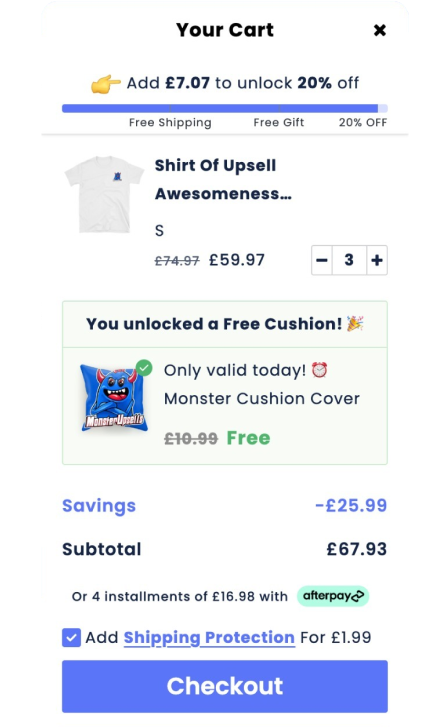
By defining clear metrics and testing different strategies, you create a continuous improvement cycle for your shopping cart. This ongoing optimization leads to steadily increasing completion rates quarter after quarter. Ready to boost your Shopify store's cart performance? Visit Monster Upsells and start maximizing your sales today!
Article created using Outrank